A Scholarly Skirmish: Ending the STEM and Humanities Debate

By Bryan Duong Milstead
“Left-brain” or “right-brain”. Engineering over English. Articulations against analytics. Most often heard, STEM versus humanities. What if it didn’t have to be this way?
For many teens (including myself), high school is a time for new social connections, developing
our authentic personalities, and joining various extracurricular activities. As we mature into young adults, we start to make more “grown-up” decisions, such as finding a career path that suits our interests and, logically, choosing classes that align with them.
Students passionate about STEM tend to gravitate towards accelerated courses in science and
math, spending the majority of the instructional day undertaking design projects. Rhetoric, philosophical texts, and musical compositions are often the focus of enthusiasts in the humanities. Now, I encourage you to consider the kid in the middle, facing an extraordinary dilemma. He enjoys both of these subjects and seeks a path that combines experimentation with creative thinking. Writing poetry fills his pastime, and so does wiring Arduino micro-controllers.

Figure 1: An example of an Arduino microcontroller (left) being wired to a breadboard (right) to
light up an LED (Zhao, 2023)
This kid is me, the author of this article — but, I know I’m not alone. Millions of other students across America enjoy fulfilling their knowledge in STEM and humanities concepts. When society continuously discourages us from unlocking our full academic potential through a divisive status quo, how are we supposed to become well-rounded change-makers of the future?
For example, people in STEM are frequently caricatured as socially awkward and overly analytical, sometimes lacking communication skills. Minority underrepresentation and socioeconomic disparity in key STEM fields only exacerbates negative viewpoints on thesciences, associating STEM with a notion of inaccessibility (Sustainability Directory, 2025).
Furthermore, an intense fear of failure often hijacks the self-esteems of students who are in the process of expanding their STEM knowledge. The hustle culture epidemic (Hutchins, 2024) paired with perceived unreasonable expectations is a disastrous recipe that prevents teens and young adults from pursuing scientific inquiry in the first place.
Stereotypes around the humanities are just as exaggerated, with adjectives such as “impractical” and “hyperemotional” constantly plaguing this field of study. Scholars within this field may face disregard due to studying topics that don’t directly utilize math or deep statistical analysis. Lastly, intellectual elitism has been entrenched in philosophy, even dating back to Europe’s Enlightenment era where salons, formal gatherings to discuss the latest philosophical concepts, were predominantly attended by and limited to the wealthy aristocracy (Brétéché, 2020).

Figure 2: Une soirée chez Mme Geoffrin, or an Oil painting depicting a Parisian salon held by
French socialite & salonnière Madame Geoffrin (Lemonnier, 2024).
As societal standards continue to stray further away from a multifaceted perspective on education, so do students. Whether it’s which subject is more “rewarding”, more “impactful”, or requires more “intelligence”, these arguments only push goal-oriented teens to opposite ends of the spectrum. This polarization and constant comparison fosters hostility between already competitive academic environments. Don’t get me wrong: competition can be healthy when itencourages us to achieve success for ourselves and others (Gloveworx, 2019) — not when it involves putting others down simply because they chose theatre over test tubes.
I was formerly a student who fell victim to the STEM-humanities comparison, believing that I could only pursue one or the other. A mere attempt to juggle both would lead me into a state of limbo, worrying that if I made the wrong decision, I wasn’t going to obtain a lucrative and fruitful career. Other ruminative thoughts filled my head: how would friends, peers, or even colleges perceive me if I affiliated myself with this field over that one? Should a rapidly growing STEM workforce prohibit me from fine-tuning my literary skills (Kennedy, Fry and Funk, 2021)?
This constant thought process of mental gymnastics can leave students like myself feeling trapped, unproductive, and frankly, exhausted. We try immensely hard to fit into rigid boxes that fail to reflect the totality of our interests.
I challenge you, the reader, to consider this: we’ve been wasting our time mindlessly arguing about the individual worth of STEM and humanities when instead, it is crucial that we recognize their potential for collaborative efforts. Why does academia continue to make one-dimensional postulations when, in the words of former Apple CEO Steve Jobs, “...technology alone is not enough – that it’s technology married with liberal arts, married with the humanities, that yields us the result that makes our hearts sing” (Goodreads, 2024)?
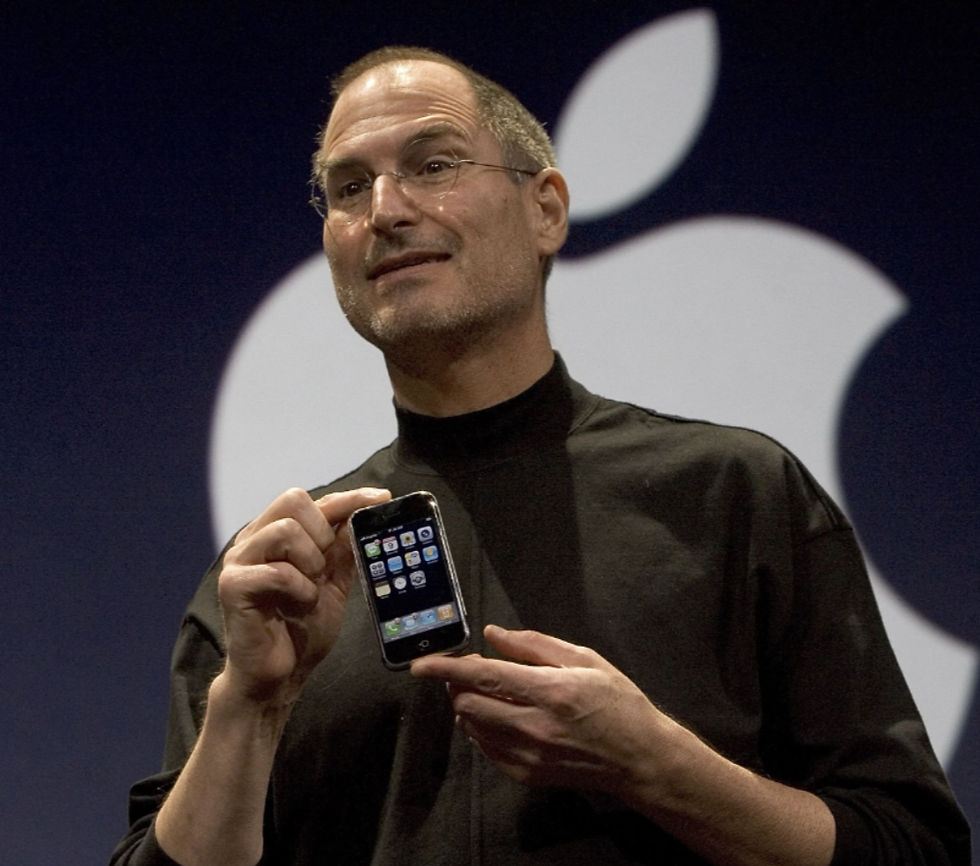
Figure 3: Steve Jobs unveils the first Apple iPhone at the 2007 Macworld Expo (Morris, 2007).
Italian Renaissance icon Leonardo da Vinci painted the most exquisite artworks — but also conducted pioneering research in neuroscience (Pevsner, 2002). Albert Einstein was extremely STEM-oriented with his groundbreaking work in theoretical physics and quantum mechanics, yet still believed in an education built on the humanities. In a 1952 New York Times article (Pearce, 2018), he thoughtfully wrote that, “It is not enough to teach a man a specialty. Through it he may become a kind of useful machine but not a harmoniously developed personality.”
The intelligentsia of the past and present have affirmed—and reaffirmed—the compatibility of these two disciplines. No longer should students conform to baseless boundaries and mindless maxims.
Thankfully, many collegiate institutions and organizations have begun to prioritize an multidisciplinary curriculum. At Baylor University’s medical humanities program, for example, the fields of philosophy, history, and English are often intertwined with biomedicine (Baylor University, 2022). Aircraft company Boeing even teamed up with Virginia Tech’s College of Liberal Arts and Human Sciences to host a course on how communication and collaboration are key for aerospace engineering (Adkins, 2023).
The Harvard Data Science Initiative is a partnership between STEM experts (particularly in computer science, statistics, and data collection) and humanities experts belonging to the disciplines of law and education (Harvard Data Science Initiative (HDSI), 2017). By developing a multifaceted, ethical perspective on analyzing data, they strive to tackle the world’s most pressing challenges.
Our high-/middle-school level educational systems have also opened their eyes regarding the STEM-humanities comparison. It’s the whole reason why the STEAM acronym (Science, Technology, Engineering, Art, Mathematics) is utilized by many enrichment programs across America (Champions, 2025). International robotics organization FIRST (For Inspiration and Recognition of Science and Technology) dedicated an entire season’s game, CENTERSTAGE, to the power of design and creativity. For a bit of context, FIRST has had more than 3.2 million youth participants impacted in more than 110+ countries since its inception in 1989 (For Inspiration and Recognition of Science and Technology (FIRST), 2015).

An example of an FTC Robot created by team #17621, "Sea Dawgs," in the FIRST South
Carolina Region (FIRST South Carolina, 2019)
When we acknowledge STEM and humanities curriculum as a dynamic duo rather than pitting them against each other, we can achieve a nuanced, interconnected understanding of the world around us. This situation reminds me of the “yin and yang”, a Chinese philosophical concept that recognizes two opposite but complementary forces that form a cohesive whole.
Reference list
Adkins, A. (2023). Virginia Tech, Boeing partner to empower students in human-centered
problem solving. [online] Vt.edu. Available at:
d-appro.html.
Baylor University (2022). F AQ’ s. [online] Baylor.edu. Available at:
Brétéché, M. (2020). Salon: A Model of Sociability for European Elites? (The) | EHNE. [online]
ehne.fr. Available at:
ciability-european-elites.
Champions (2025). STEAM Programs | Grades K-8 | Champions. [online]
Discoverchampions.com. Available at:
ams/steam-programs.
FIRST South Carolina (2019). FIRST South Carolina. [online] FIRST South Carolina. Available
For Inspiration and Recognition of Science and Technology (FIRST) (2015). At A Glance.
[online] FIRST. Available at: https://www.firstinspires.org/about/at-a-glance.
Gloveworx (2019). Healthy vs. Unhealthy Competition. [online] Gloveworx. Available at:
https://www.gloveworx.com/blog/healthy-vs-unhealthy-competition/.Goodreads (2024). A quote by Steve Jobs. [online] Goodreads.com. Available at:
Harvard Data Science Initiative (HDSI) (2017). Mission & Vision. [online] HDSI. Available at:
Hutchins, H. (2024). STEM’ s Hustle Culture Virus — Minding The Campus. [online] Minding
The Campus. Available at:
Kennedy, B., Fry, R. and Funk, C. (2021). 6 facts about America’ s STEM workforce and those
training for it. [online] Pew Research Center. Available at:
d-those-training-for-it/.
Lemonnier, A. (2024). Salon of Madame Geoffrin. [online] World History Encyclopedia.
Morris, D. (2007). Apple CEO Steve Jobs holds up the new iPhone that was introduced at...
[online] Getty Images. Available at:
hat-was-news-photo/72955624?adppopup=true.
Pearce, J. (2018). Einstein on the Humanities. [online] The Imaginative Conservative. Available
at:
Pevsner, J. (2002). Leonardo da Vinci’s contributions to neuroscience. Trends in neurosciences,
[online] 25(4), pp.217–20. doi:https://doi.org/10.1016/s0166-2236(00)02121-4.
Sustainability Directory (2025). Socioeconomic STEM Disparities → Term. [online] Climate →
Sustainability Directory. Available at:
https://climate.sustainability-directory.com/term/socioeconomic-stem-disparities/.Zhao, C. (2023). Close-up of Semiconnectors · Free Stock Photo. [online] Pexels. Available at: https://www.pexels.com/photo/close-up-of-semiconnectors-15470542/.

Commentaires